
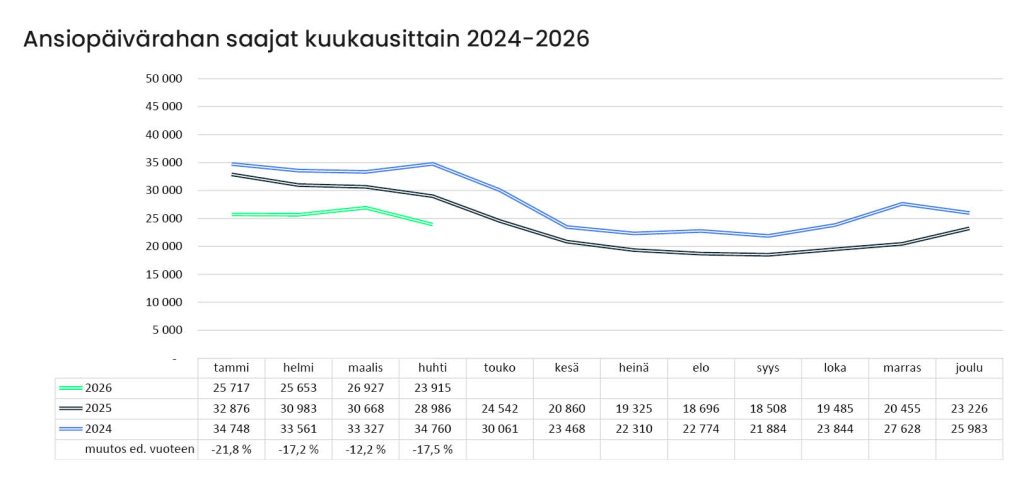
In April, the number of recipients of earnings-related allowance from Open Unemployment Fund continued to decline significantly. There were more than 17 percent fewer recipients than a year earlier, and the number of applications also dropped sharply. Data from mid-May indicates that the downward trend is continuing. The number of people receiving allowance during layoffs also decreased, but the share of laid-off recipients among all allowance recipients remains relatively high at 37 percent.
Sharp decline in the number of applications
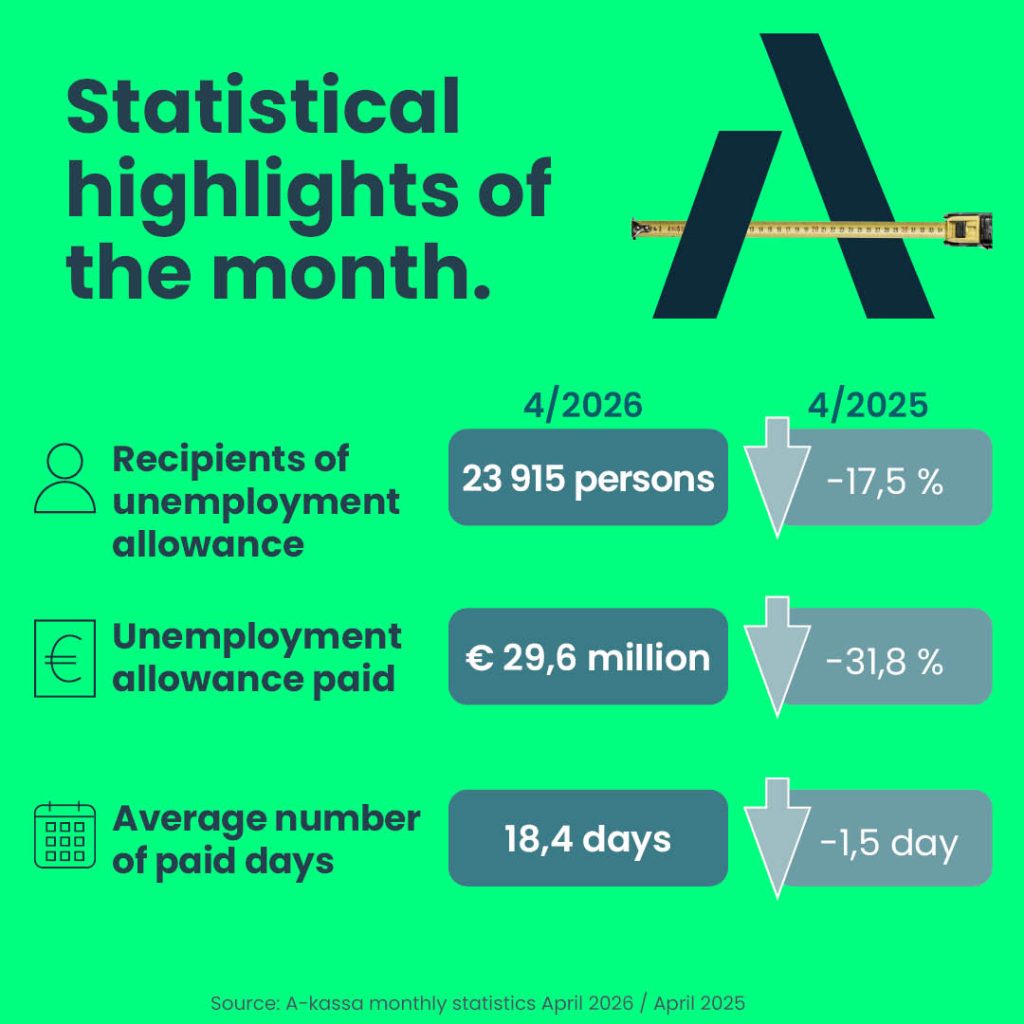
In April, 23,915 A-kassa members received earnings-related allowance, which is 17.5 percent fewer than a year earlier. Compared to March, the number of recipients decreased by more than 3,000 people. The share of allowance recipients among members was 9.8 percent, which is 1.7 percentage points lower than at the same time last year. Finland’s overall unemployment rate was 11.2 percent in March.
The number of applications dropped sharply from the March figures. In April, 28,097 applications were received, which is as much as 24.6 percent fewer than in March and 15.2 percent fewer than a year earlier. According to data from early May, the decline in application volumes appears to be continuing. By mid-May, 13,346 applications had been received, compared to 15,123 by mid-April.
– The figures for April suggest that the sharpest spike in applications seen at the beginning of the year may have levelled off. However, the share of laid-off recipients remains high, which indicates that uncertainty in the labour market is continuing, particularly in industrial sectors, says Kaisa Tikka, Administrative Director of A-kassa.
Initial applications decreased significantly
The number of initial applications remained at 1,318 in April. There were 12 percent fewer initial applications than a year earlier and 44.3 percent fewer than in March. Initial applications accounted for 4.7 percent of all applications, compared to 6.3 percent in March.
– The clear decrease in the number of initial applications may indicate that fewer new periods of unemployment are beginning now than at the start of the year, although there are still differences between sectors, Tikka estimates.
The share of laid-off recipients remains high
In April, 8,930 members received allowance during layoffs, which is 18 percent fewer than in March and 17.2 percent fewer than a year earlier. However, the share of laid-off recipients among all allowance recipients remained high at 37.3 percent. In March, the share of laid-off recipients was 40.5 percent, meaning the proportion decreased by 3.2 percentage points over the month. Compared to April last year, however, the share of laid-off recipients is almost unchanged, increasing by only 0.1 percentage points.
Data from early May shows that the number of laid-off recipients continues to decline slightly. By mid-May, there were 4,062 laid-off recipients of earnings-related allowance, which is 17.2 percent fewer than in mid-April.
Earnings-related allowance costs decreased
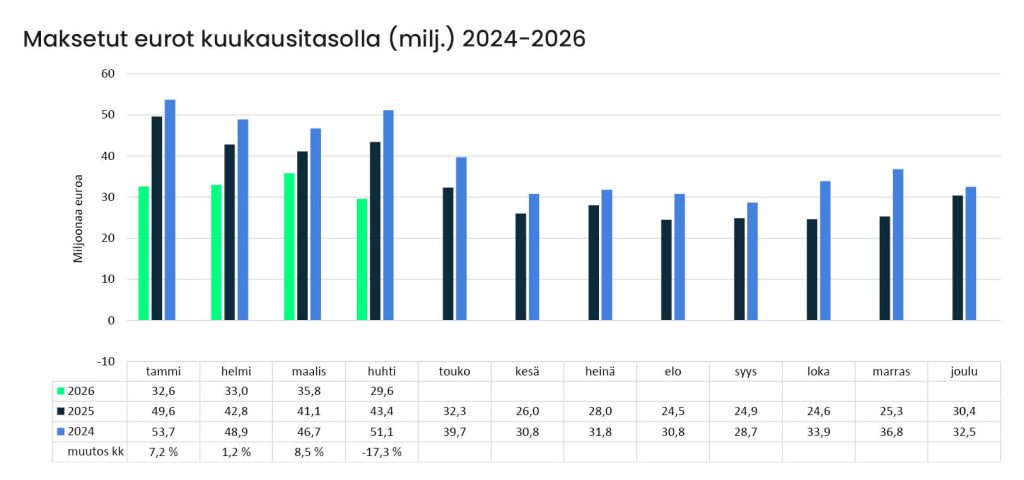
A total of €29.6 million in earnings-related allowance was paid in April, which is 17.3 percent less than in March. Compared to a year earlier, the costs were 31.8 percent lower.
The average number of paid days in April was 18.4 days, which is 0.8 days fewer than in March and 1.5 days fewer than in April last year.
The decline appears to be continuing in May
Based on data from mid-May, the decline in the number of earnings-related allowance recipients has continued. By mid-May, earnings-related allowance had been paid to 13,156 members. This is 12.9 percent fewer than in mid-April. In mid-April, there were 15,108 recipients, and during the whole of April, a total of 23,915 members received earnings-related allowance. A year earlier, in mid-May, there were 16,507 recipients, meaning the number is now 20 percent lower.
Most A-kassa members work in industry, construction, and the automotive and transport sectors. The statistics therefore primarily reflect developments in these sectors. In addition to the general employment situation, changes in the number of recipients may also be affected by legislative changes to unemployment security, such as changes to the conditions for receiving earnings-related allowance.