
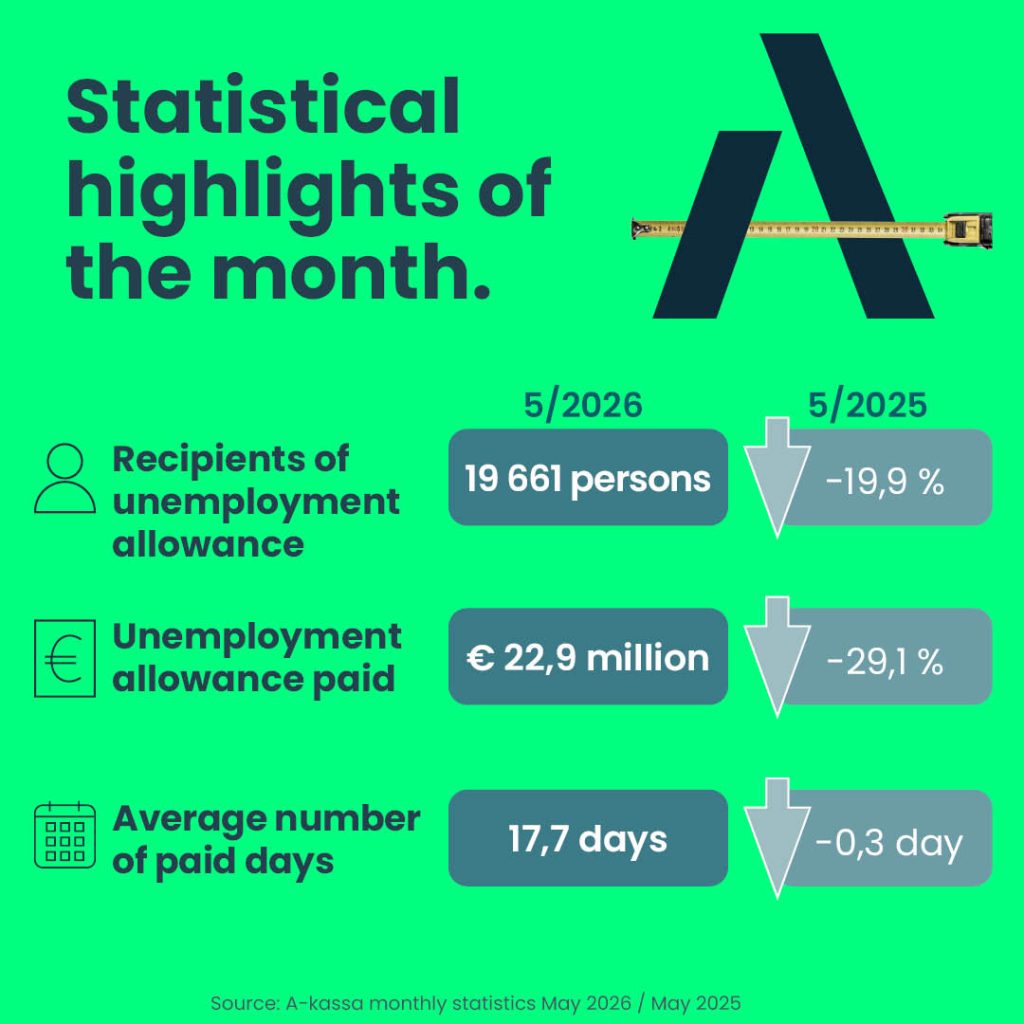
The number of recipients of earnings-related unemployment allowance from A-kassa continued to decline sharply in May and was nearly one fifth lower than a year earlier. At the same time, the number of people who reached the maximum benefit period has not increased, suggesting that long-term unemployment among A-kassa members is not on the rise.
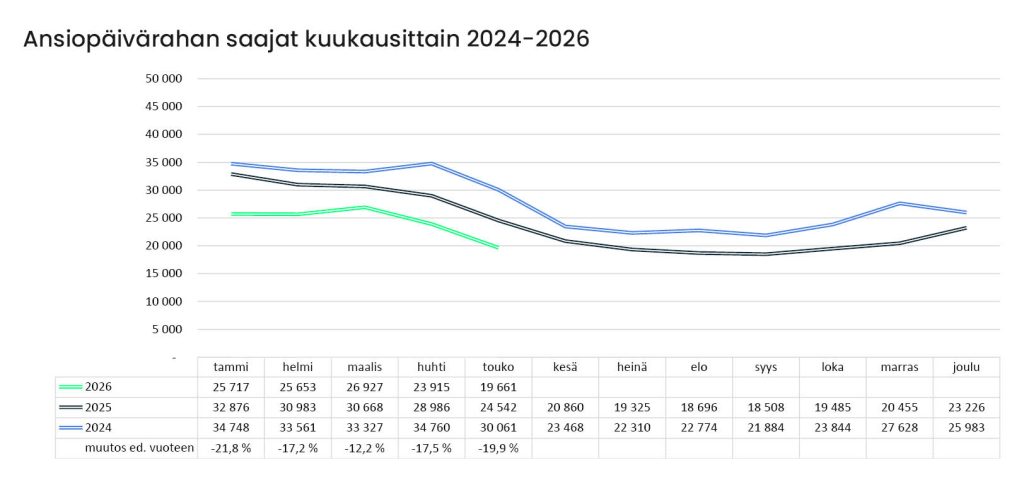
In May, 19,661 A-kassa members received earnings-related unemployment allowance, meaning that the number of recipients decreased by more than 4,000 compared with April. Compared with the previous year, the decline is slightly larger, almost 20 percent. The decrease follows the typical seasonal trend seen in spring and summer: the number of recipients drops sharply until summer and then remains relatively stable until autumn.
In May, 8.1 percent of A-kassa members received earnings-related unemployment allowance. This is 1.7 percentage points lower than in April and at the same time last year. Finland’s overall unemployment rate was 11.9 percent in April, indicating that the unemployment situation among A-kassa members is better than the national average.
Cautiously Positive Signs in Long-Term Unemployment Trends
The number of earnings-related allowance recipients has declined significantly during the first part of the year, while the number of people reaching the maximum benefit period has not increased. In May, 388 people reached the maximum benefit period, fewer than in April (498 people) and almost the same number as a year earlier. Reaching the maximum benefit period means that a person has exhausted their entitlement to earnings-related unemployment allowance and can no longer receive the benefit.
– Developments in long-term unemployment can be assessed, among other indicators, by monitoring the number of people who reach the maximum benefit period. Although the number of earnings-related allowance recipients has decreased sharply, our statistics do not show signs that an increasing number of members are exhausting their full entitlement to earnings-related allowance. Based on our data, unemployment spells do not currently appear to be becoming longer among our members than before. This is a cautiously positive signal regarding labour market developments,” says Kaisa Tikka, Director of Administration at A-kassa.
However, changes in the number of recipients are also influenced by legislative amendments to unemployment security, meaning that no straightforward conclusions about labour market developments can be drawn solely from these statistics.
Share of Laid-Off Recipients Has Decreased
The number of people receiving unemployment allowance during temporary lay-offs also declined significantly in May. At the end of the month, laid-off members accounted for 33 percent of all allowance recipients. The decline appears to be continuing in June, as by mid-June the share of recipients receiving lay-off benefits had already fallen to 26 percent.
– The decrease in the number of allowance recipients and the declining share of laid-off members are very typical spring and summer phenomena among our membership. Many of our members work in industry and construction, where employment opportunities are generally better during the summer season,” says Tikka.
The increase in the number of recipients of mobility allowance also indicates that members are more willing than before to accept work outside their usual commuting area.
Decline Expected to Continue in June
Based on data from mid-June, the number of earnings-related allowance recipients continues to decrease, although at a slower pace. By mid-June, earnings-related unemployment allowance had been paid to 10,925 members. This is 17 percent fewer than at the same point in May. By mid-May, there were 13,156 recipients, and during the entire month of May, a total of 19,661 members received earnings-related unemployment allowance. A year earlier, there were 13,415 recipients at mid-June, representing a 19 percent decrease from the previous year. The number of applications submitted at the beginning of June has also remained lower than last year.
Most A-kassa members work in industry, construction, and the automotive and transport sectors. The statistics therefore primarily reflect developments in these industries. In addition to the overall employment situation, changes in recipient numbers may also be affected by legislative amendments to unemployment security, such as changes to the conditions for receiving earnings-related unemployment allowance.