
In February, the number of recipients of earnings-related allowance from the A-kassa continued to decrease compared to last year, but on a monthly level the situation remained almost unchanged. The number of applications received in February was clearly lower than a year earlier, and in particular the number of first applications declined from January. At the same time, the share of laid-off persons remained high, and although the number of recipients decreased, expenditure on earnings-related allowance increased slightly compared to the previous month. Figures from early March suggest that the number of recipients may be turning to a gradual increase again.
– Typically, the number of applications decreases towards spring, but it is still difficult to say what this spring will look like. However, the decrease in the number of first applications is a positive sign, says Kaisa Tikka, A-kassa’s Director of Administration.
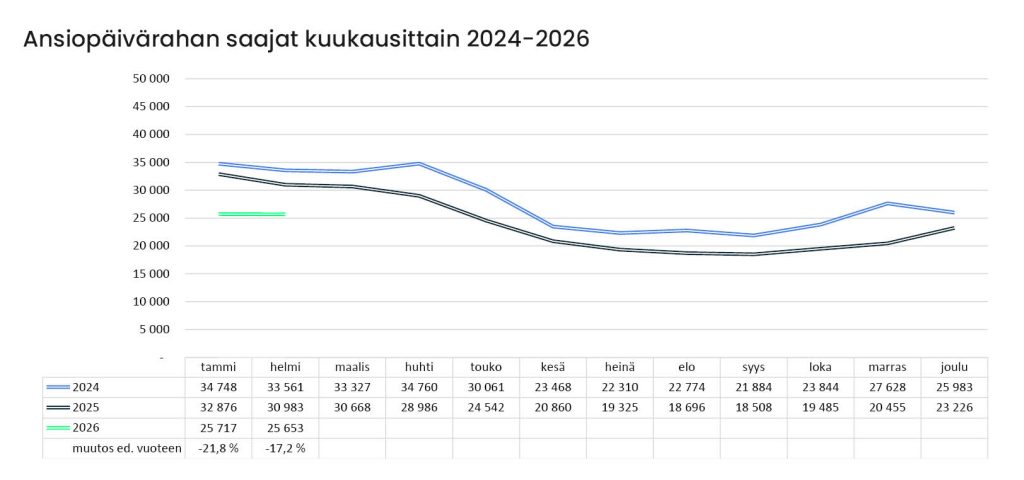
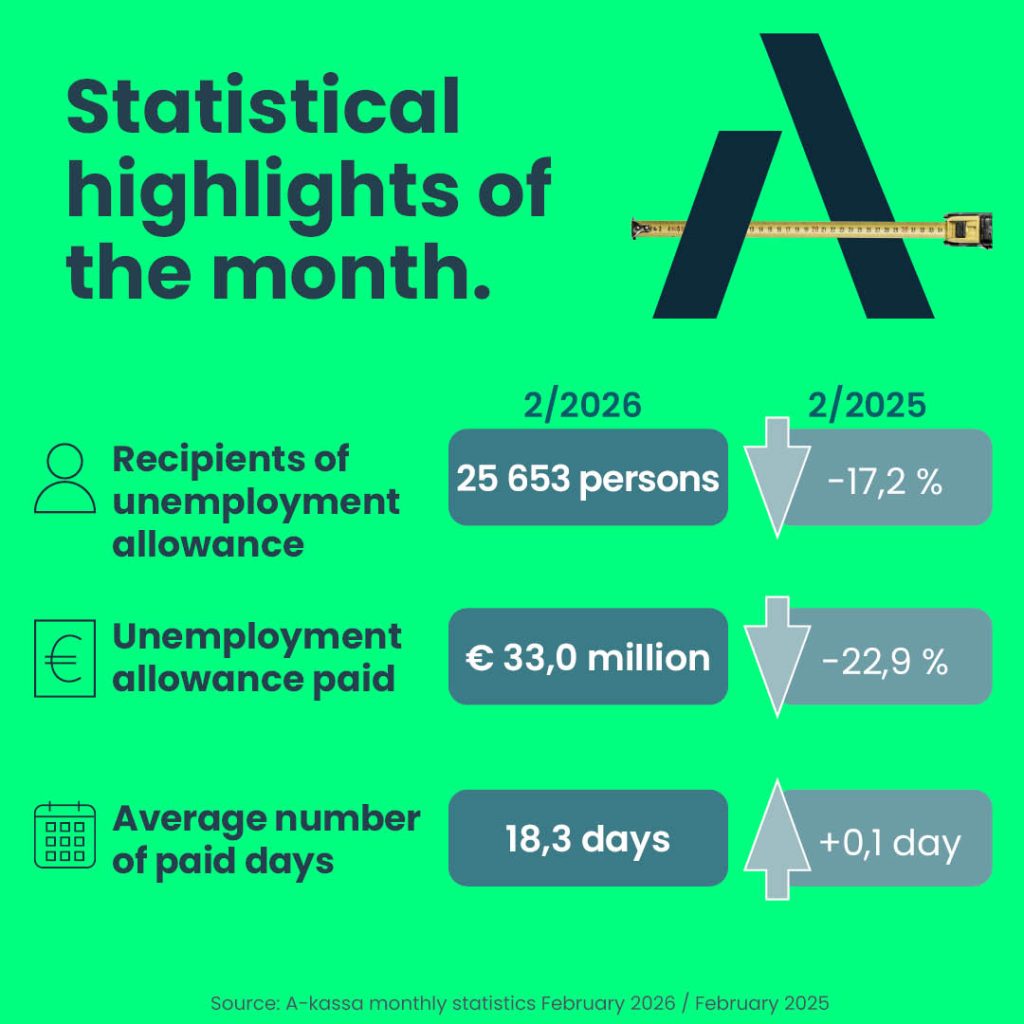
In February, 25,653 members received earnings-related allowance from A-kassa, which is 17.2 % fewer than a year earlier. Compared to the previous month, the number of recipients remained almost unchanged, decreasing by only 0.2 %.
The number of applications has decreased significantly compared to last year. A total of 29,408 applications were received in February, which is 20.1 % fewer than in February last year. Compared to January, the number of applications also decreased clearly, by 16.1 %.
In February, 10.5% of A-kassa’s members received earnings-related allowance, which is 1.8 percentage points less than a year earlier
The number of first applications dropped from the previous month
In February, 1,961 first applications were submitted, which is 15.3 % fewer than a year earlier. Compared to January, the number of first applications decreased significantly, by as much as 40.9 %.
First applications accounted for 6.7 % of all applications in February, compared to 9.5 % in the previous month.
The share of laid-off persons remained high
In February, 9,978 people received earnings-related allowance during a lay-off. The number of laid-off persons is 20.0% lower than a year earlier and 2.0% lower than in the previous month.
The share of laid-off persons among all recipients of earnings-related allowance in February remained at nearly the same level as last year. The share was now 39 %, compared to 40 % a year earlier.
Expenditure on earnings-related allowance increased despite a decrease in recipients
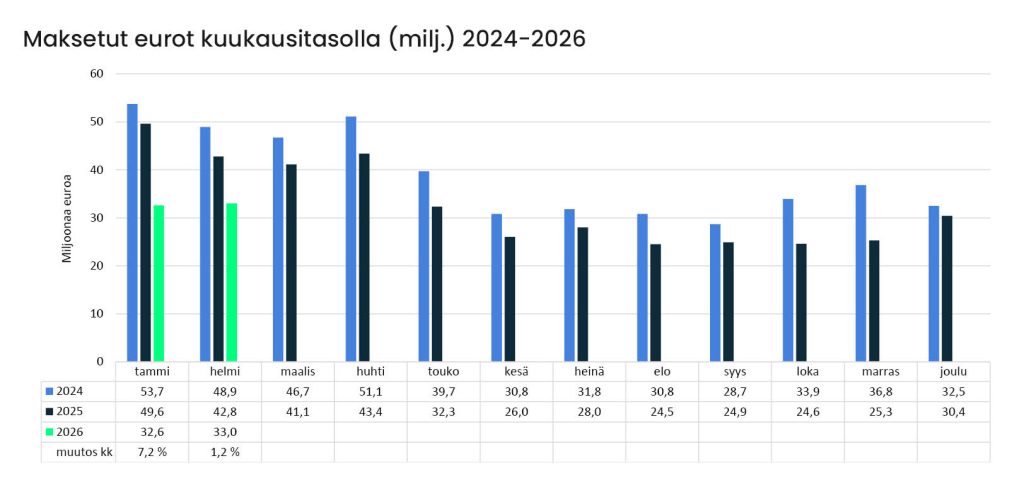
Expenditure on earnings-related allowance increased by 1.2 % in February compared to January. A total of EUR 33.0 million was paid in earnings-related allowance in February, compared to EUR 32.6 million in January. Compared to last year, the amount paid in February was 22.9 % lower.
It is noteworthy that the total amount paid has increased since January even though the number of recipients has decreased. This is explained, among other things, by the fact that the number of fully unemployed persons is slightly higher and the number of recipients of adjusted allowance slightly lower than in January.
The average number of paid days in February was 18.3 days, which is 0.4 days more than in January and 0.1 days more than in February last year.
Signs of an increase in the number of recipients in March
By mid-March, earnings-related allowance had been paid to 17,025 members, which is 563 more than at mid-month in the previous month. In mid-February, there were 16,462 recipients, and during the whole of February, a total of 25,653 members received earnings-related allowance. A year earlier, there were 21,072 recipients at mid-March, so the number is now 19.2 % lower.
By mid-March, allowance during lay-off had been paid to 6,206 members, corresponding to 36 % of all recipients. The share of laid-off persons therefore appears to be slightly decreasing.
The majority of A-kassa’s members work in industry, construction, and the automotive and transport sectors. The statistics therefore primarily reflect developments in these sectors. Changes in the number of recipients may, in addition to the general employment situation, also be influenced by legislative changes in unemployment security, such as changes to the employment condition and the conditions for earnings-related allowance.